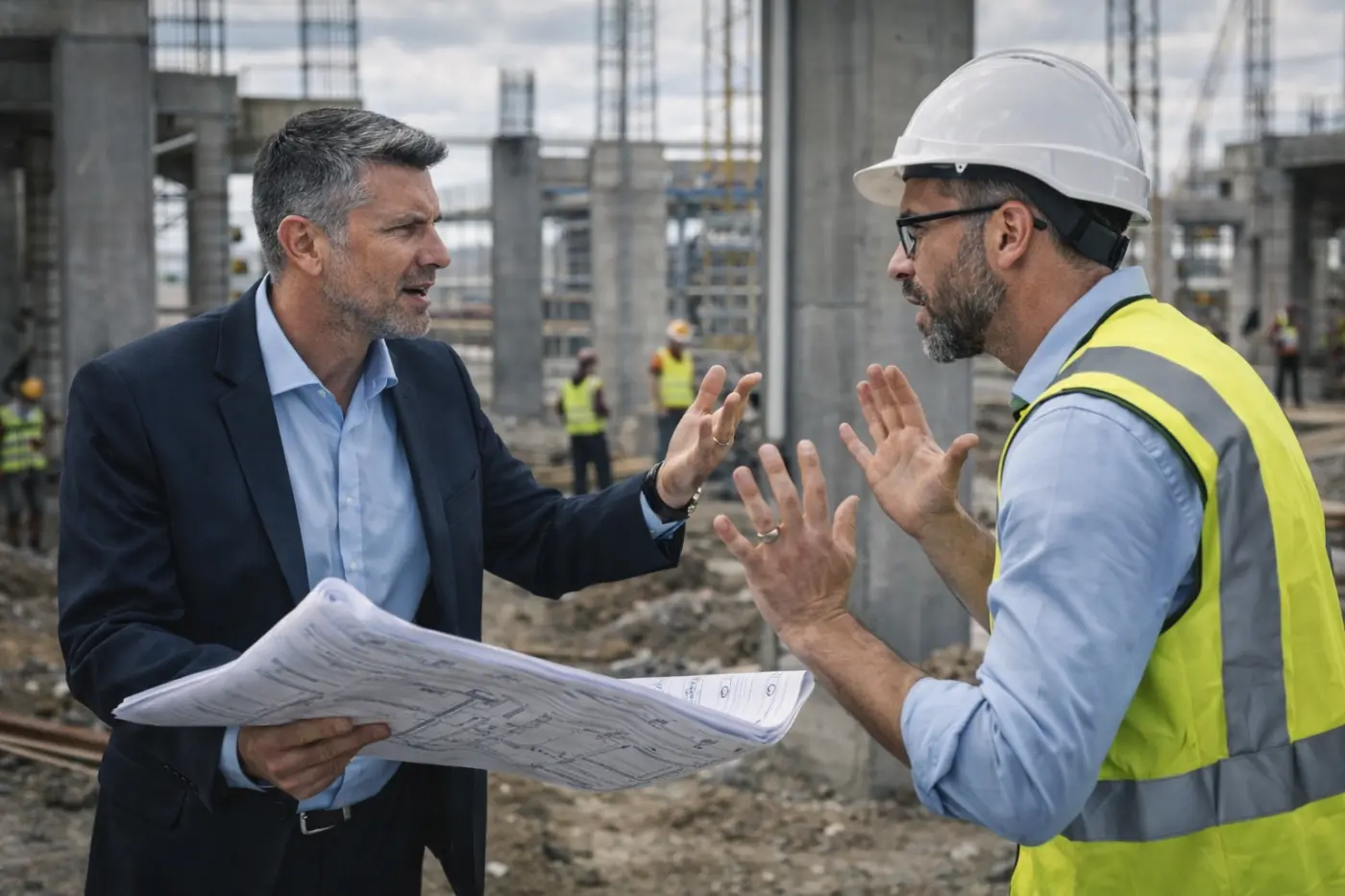
There’s a quiet but persistent tension running through almost every building project.
Design teams believe they’ve communicated intent clearly.
Construction teams believe they’ve been handed ambiguity wrapped in drawings.
Both are right. And both are frustrated.
The issue isn’t competence or effort—it’s culture, focus, and structural misalignment between what design organisations are built to do and what construction environments require to execute.
Design Thinking vs Construction Reality
Architectural practices are culturally optimised for:
Construction environments, by contrast, are optimised for:
Neither is “better.”
But pretending one culture can fully serve the other—without translation—is where projects break down.
The Myth: “The Drawings Are Detailed Enough”
From the construction side, the expectation is simple:
“If it’s issued, it should be buildable.”
From the design side, the assumption is different:
“If it’s unclear, the builder will resolve it.”
That gap is not a technical one—it’s a cultural blind spot.
Design practices are not inefficient because they lack skill.
They are inefficient when asked to operate outside their natural strength zone.
The closer a project gets to fabrication, sequencing, and tolerance management, the further it moves away from design thinking—and the deeper it moves into a different discipline entirely.
Enter the Missing Middle
This is where the technician, draftsperson, BIM author, and digital delivery specialist actually sit.
Not as “support roles.”
Not as downstream production.
But as the translation layer between intent and execution.
This middle layer:
Without it, construction teams end up doing design resolution under time pressure, cost pressure, and contractual friction—exactly the environment where quality drops and risk explodes.
Why Architectural Practices Can’t Fully Solve This (and Shouldn’t Try)
Even the best architectural studios face structural constraints:
None of this is a failure. It’s specialisation.
Expecting a design-led organisation to consistently deliver construction-grade clarity is like asking a strategy firm to also run operations. Possible in theory. Inefficient in practice.
And expensive.
Specialisation Is Efficiency, Not Fragmentation
The most efficient project teams aren’t the ones where everyone does everything.
They’re the ones where:
This isn’t about adding cost.
It’s about putting effort where it creates the most leverage.
When the middle is properly resourced:
Ironically, design outcomes improve when designers are no longer forced to resolve construction problems under duress.
The Real Cultural Shift Required
The industry doesn’t need better software.
It needs clearer role definition.
Design ≠ documentation ≠ digital delivery ≠ construction
They are linked—but not interchangeable.
Elevating the technician, BIM author, and digital delivery role isn’t about hierarchy.
It’s about acknowledging where certainty is actually created.
And certainty is what construction runs on.
Bottom line:
When specialists stay in their strength zones—and the missing middle is properly valued—projects move faster, cost less, and break less often.
That’s not a technology insight.
It’s an organisational one.